
LeadershipPublished
The leaders of the future are Value Creators
This article was translated from danish using AI. Read the original
The debate around leadership versus management can quickly become both sharp and, quite honestly, a little tiring. It often goes round in circles between control logic on one side and lofty platitudes on the other. That is why I have long been missing a concept that better captures the role of the leader of the future. A concept that holds both the healthy elements of management and the human dimensions of leadership, while also pointing towards something more meaningful.
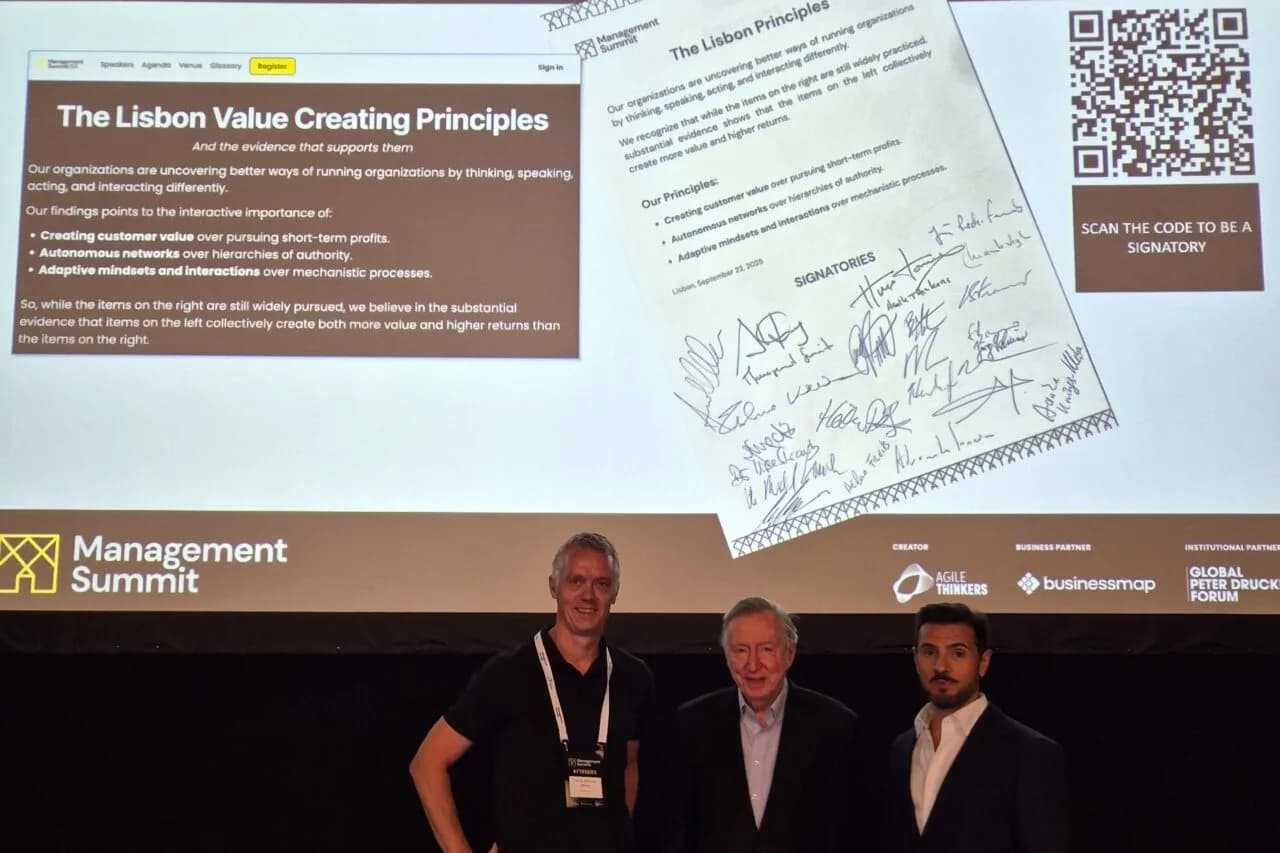
Perhaps that is what is captured in the concept of Value Creators, which I was introduced to at the Management Summit in Lisbon by Steve Denning, Heidi Musser and Hugo Lourenco.
For me, it touches something absolutely central. In their definition, value creation is not only about creating value for one stakeholder group, typically shareholders or owners, through a short-term focus on profit. Value Creators work from a holistic and long-term perspective, where owners, customers, employees, partners, society and the planet are all part of the equation.
The three principles behind Value Creators
The concept of Value Creators is supported by the three Lisbon principles for value creation:
- Create customer value rather than chasing short-term profit
- Autonomous networks rather than authority hierarchies
- Adaptive mindsets and interactions rather than mechanical processes
These principles redefine what leadership is about. They point towards a new practice in which leaders measure themselves by their ability to create the conditions for others to succeed, not by the number of decisions they make themselves.
What does it mean to be a Value Creator?
Being a Value Creator is about shifting the focus from control to context. Instead of optimising processes at any cost, the Value Creator asks themselves, and the organisation, one fundamental question:
What value are we creating, and for whom?
That question reflects a perspective that stretches far beyond KPIs and quarterly accounts. With it follows a set of practices and attitudes that distinguish Value Creators from traditional leaders:
- They connect everyday decisions to a larger purpose.
- They design environments that enable others to succeed.
- They see innovation as a continuous movement, not a project.
- And they put empathy and relationships at the centre.
Why is the shift necessary?
We live in a world marked by constant change: geopolitical instability, new technologies, artificial intelligence, sustainability demands and growing complexity. No leader can have all the answers any longer. Leadership is therefore about creating the conditions in which the organisation can act, learn and adapt, again and again.
The role is not new
When I come across the concept of Value Creators, I cannot help thinking of one of the most innovative leadership ideas of the 20th century: Servant Leadership.
Robert K. Greenleaf introduced the concept in 1970 with the argument that a leader is first and foremost there to serve others. A way of thinking that puts employees, customers and society at the centre. The intention was almost identical to the thinking behind Value Creators: to create the conditions in which people grow, thrive and are able to contribute.
But the word servant has often been misunderstood over time. For some, it carries the tone of being a “useful idiot”, detached from the commercial reality in which companies must balance people, purpose and profit. That was probably never Greenleaf’s intention, but the label got in the way of the strength within the idea.
Value Creators builds on Greenleaf’s thinking, but with language that both embraces the human side of leadership and acknowledges the commercial reality we operate in. Value Creators keep their eye on the ball, but they also look far ahead.
Leadership for the future
If we as leaders are to remain relevant in the future, we need to step into the role of Value Creators. That means asking ourselves, every day:
- What value am I creating today, and for whom?
- What conditions am I creating that enable others to succeed?
- How am I helping our organisation remain adaptive, innovative and human?
Leadership in the 21st century is no longer about managing resources. It is about creating the conditions for value creation.
The conference in Lisbon has set many thoughts in motion for me, and I am deeply inspired by the concept of Value Creators. Perhaps this is exactly the concept that can help us translate good intentions into practice and begin leading in ways that do not just create results, but real value for people, organisations and the societies around us.
Image: Steve Denning, Hugo Lourenco and myself at the launch of the Lisbon principles at the Management Summit conference. The principles had been signed the evening before by around 20 visionary CEOs.
Last edited: