
Denne artikel er oversat fra dansk med AI
A new logic for digital product development
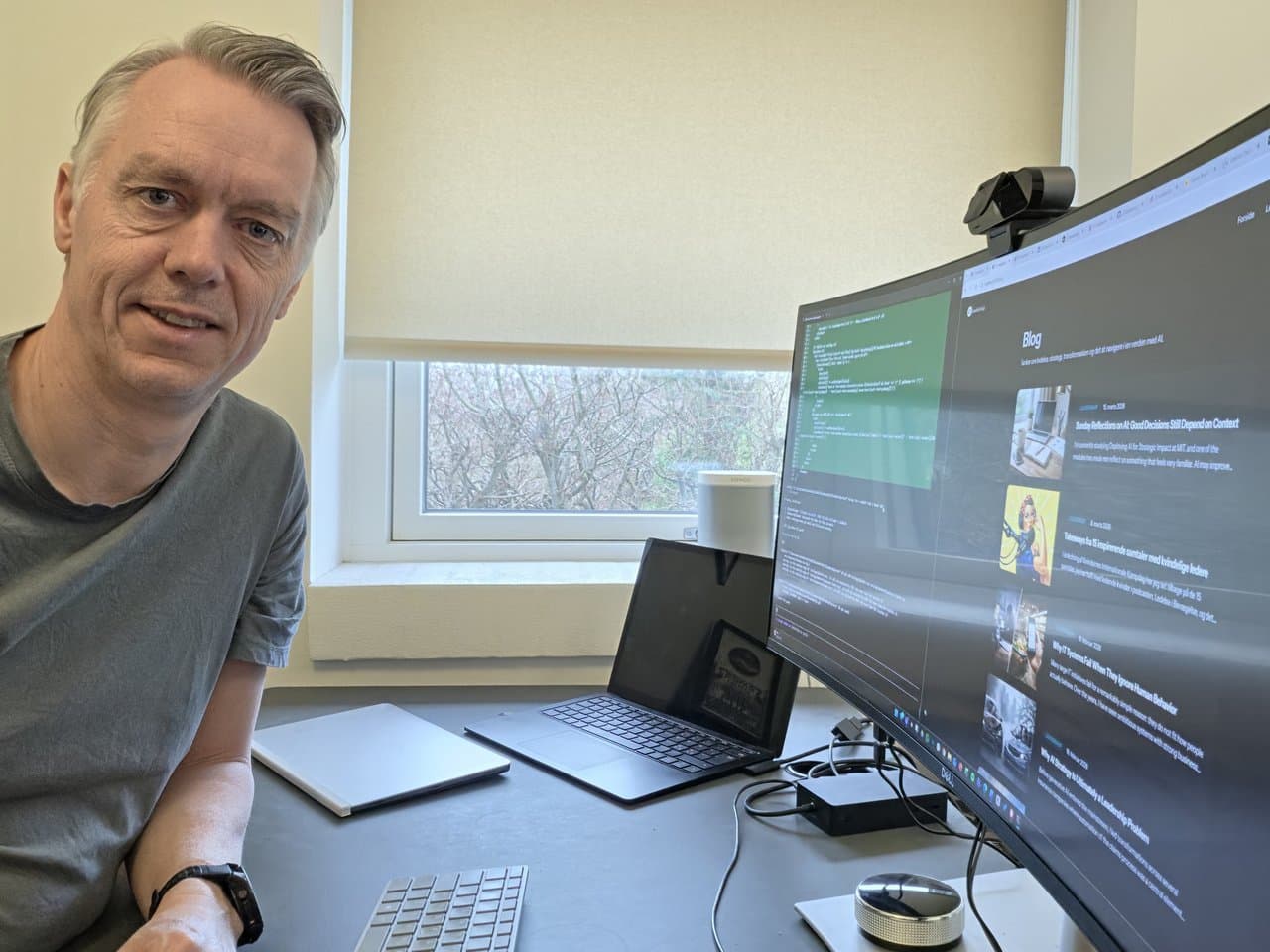
If you’re reading this, you’ve landed on my new website – welcome.
You may also have noticed that you can switch between light and dark mode. It’s a small feature. But it’s also a very good example of how vibe coding, agents, and other new AI tools will fundamentally change digital product development.
The feature itself is, of course, not revolutionary. But I think it matters for the experience. Previously, even something relatively simple like this would quickly have turned into a technical task involving the choice of libraries, frontend logic, state management, persistence, and deployment.
This time, it could be built and deployed with just a few simple prompts. That’s not just clever. It’s strategically interesting. Because when the distance between idea and implementation shrinks this dramatically, it doesn’t just change the speed of development. It also changes who can create, how teams work, and where leadership attention needs to be.
Goodbye to an old logic – and to WordPress
Like many others, I’ve previously used WordPress. And WordPress can still be the right solution in many contexts. But it also represents a particular logic for digital development. A logic where you choose a large, generic platform, build on top of it with themes and plugins, and often end up with a solution that can do a lot, but rarely feels quite right.
This time, I chose to build it from scratch using Claude Code. It wasn’t just a different experience and a faster way to build a website, but a fundamentally different experience of the relationship between idea and execution. A much more direct path from intention to a working solution. A sense that the digital no longer has to be translated through a series of technical intermediaries before it can become reality.
I find that shift genuinely interesting.
Vibe coding is not just a new way of coding
In my view, the most interesting aspect of vibe coding is not that AI can write code faster. The most interesting part is that natural language is increasingly becoming the interface for product development.
When that happens, value shifts. Not away from technology, but upward. Away from pure implementation and toward intention, context, prioritization, and judgment. That means more people can get closer to the actual creation of digital products. Not just developers, but also product people, leaders, and domain experts.
That’s why I see vibe coding as more than a developer tool. I see it as the beginning of a real democratization of product development.
Product and technology are merging
For years, many organizations have been structured as if product and technology were two clearly separate domains. Product worked with needs, hypotheses, prioritization, and customer experience. Technology worked with architecture, implementation, quality, and delivery.
Even in well-functioning organizations, the relationship between the two has often been shaped by handovers, translations, waiting time, and misunderstandings. And sometimes a slightly too comfortable division of labor, where product could wish for things, and technology could explain why they were expensive or difficult.
That separation becomes harder to maintain in a world of vibe coding and agent-based tools.
When product people can prototype faster, when technological possibilities can be explored directly through prompts, and when implementation can increasingly be accelerated by AI, product moves closer to technology. At the same time, the role of technology becomes less about pure production and more about architecture, security, review, quality, and orchestration.
That doesn’t mean everyone needs to do the same things. But it does mean that product and technology increasingly merge in practice. And that is exactly why I believe strong leadership profiles that can operate in the space between product and technology will become even more important in the years ahead. They become a real leadership response to a new reality.
The real competitive advantage is shifting
As it becomes easier and cheaper to build, scarcity shifts. Previously, a significant part of the challenge was simply getting something built at all. It required access to specialists, budgets, capacity, and often substantial coordination. Going forward, that will in many cases be less of a problem.
So where does the new bottleneck emerge?
The new bottleneck will not be the ability to produce software, but the ability to choose well.
Which problems are worth solving? Where should we experiment quickly? Where should we hold back? What is an impressive demo, and what is a robust product? What should be built as a lightweight prototype, and what requires real engineering discipline from the start?
This is where product, technology, and strategy truly begin to merge.
This is why vibe coding is also a leadership topic
It’s easy to see vibe coding as just another technological buzzword. But the most interesting consequences are not technical. They are organizational and leadership-related. Because when more people can build, and when time-to-learn drops dramatically, it changes the requirements for prioritization, governance, and organizational design.
It raises some fundamental questions:
How do we ensure that speed doesn’t just create more understanding debt?
How do we avoid organizations building black-box solutions that no one truly understands or can maintain?
How do we design ways of working where AI becomes a real accelerator, and not just a generator of mediocrity at high speed?
How do we develop talent when entry-level tasks are increasingly automated away?
How do we balance local experimentation with shared architecture, security, and accountability?
These are not questions you can park in a technical corner. They are questions that call for leadership at the intersection of product, technology, and organization.
The role of the technology leader becomes more strategic
I don’t believe AI makes technology leadership less important. I believe it makes it more strategic.
The traditional view of the technology leader as someone who primarily ensures delivery capacity and technical quality is no longer sufficient. The technology leader of the future needs to work much closer to product strategy, operating model, prioritization, and capability development.
It’s less about leading a code factory and more about designing a system where humans and AI agents together can create value quickly without losing coherence, robustness, or direction.
That requires technological insight. But it also requires business understanding, product understanding, and organizational judgment. Product and technology are unlikely to become the same thing anytime soon, but they will increasingly be difficult to lead well in isolation.
AI does not make engineering obsolete
It’s also important to be clear about what this development does not mean. It does not mean that expertise disappears. Nor does it mean that you can simply prompt your way to great products. Quite the opposite.
When AI can generate large amounts of code quickly, architecture, review, testing, security, and coherence become even more important.
The risk is not that we cannot build. The risk is that we build faster than we understand. And when that happens, understanding debt emerges. The solutions may work now. But they become harder to change, harder to trust, and harder to scale.
That’s why I believe the best organizations going forward will be those that can combine experimental speed with high discipline. Vibe coding where it makes sense. More structured engineering where the consequences are greater. It’s not an either-or. And it is a leadership task to understand the difference.
This is only the beginning
It’s 20 years since I last wrote code, but it still feels completely natural to use Claude Code and other AI tools professionally and personally. And I expect this to become an even greater focus area for me going forward.
Not because the tools themselves are new and fascinating – although they are – but because they change some of the fundamental assumptions about how we build digital products, organize teams, and create momentum.
For me, my new website is therefore not just a new website.
It is a small, concrete example that we are moving into a reality where more people can create digital solutions. Where the path from idea to product becomes significantly shorter. Where product and technology merge more. And where leadership’s most important task increasingly becomes setting direction, creating coherence, and ensuring sound judgment in a landscape where the pace will only accelerate.
It is a development I am excited to be part of.
And we are only just getting started.