
I recently facilitated a two-day strategy workshop with the extended leadership team of a successful SaaS company.
I cannot share which company, and I cannot go into the specifics discussed in the room. But I can say that a significant part of our discussion focused on the changing landscape of SaaS, and on where durable advantage may lie as AI becomes more deeply embedded in how software is built and used.
For a long time, many SaaS businesses could rely on a familiar logic.
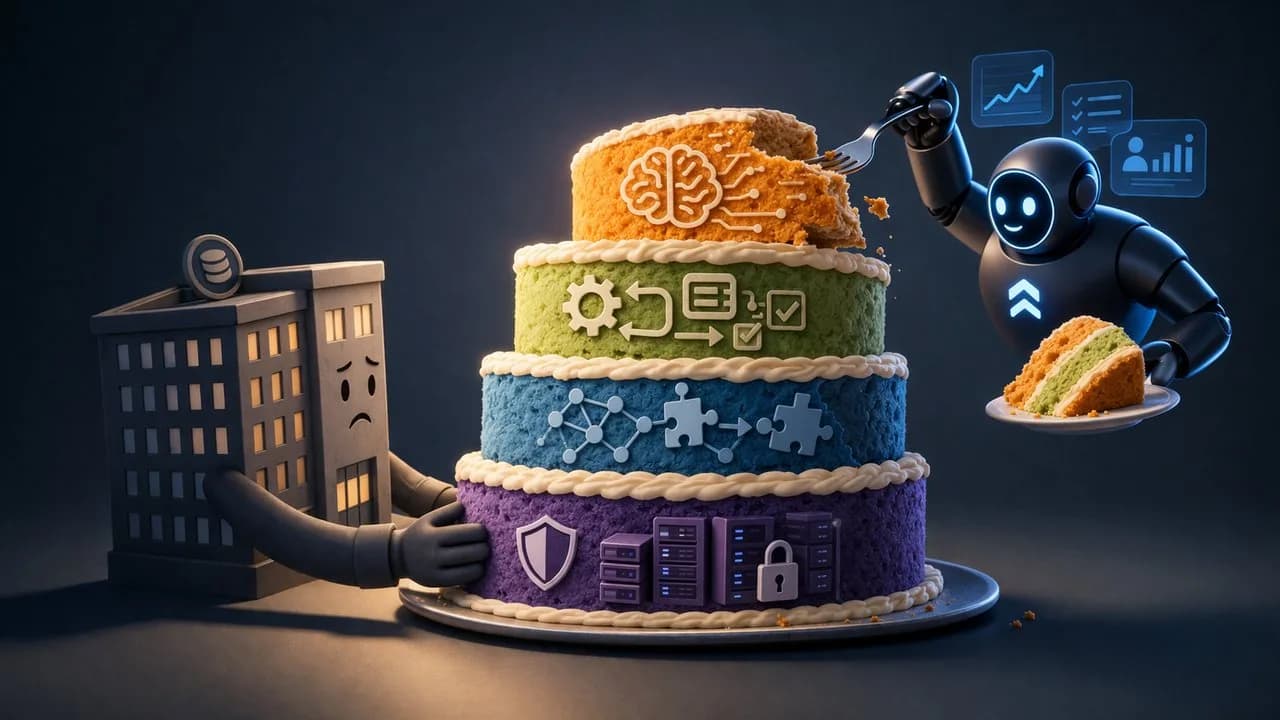
The record layer is the core system that has to be correct, stable, compliant, and trusted. In many categories, that alone has historically created a strong position. If you hold the authoritative data, handle the critical transactions, and are deeply embedded in daily operations, you matter.
The coordination layer sits around that core. This is where integrations, workflows across systems, and interfaces into the surrounding HR, finance, and IT landscape live. It is the layer that helps software fit into a broader operating environment rather than stand alone.
The execution layer is where manual effort gets removed. This is the layer of checks, approvals, filings, workflows, and standardized process support. It is where software starts to do more than store and route information. It starts to take work away.
The guidance layer is the one now being accelerated by AI. This is where software begins to recommend, prioritize, flag risks, support judgment, and in some cases act with a degree of delegated intelligence under clear governance. It is the layer closest to insight and decision support.
I find this model useful because it helps explain what AI is actually changing in SaaS. Not everything at once, and not all layers equally. The old logic does not disappear overnight. But the balance is clearly beginning to shift.
AI makes it faster to build, especially in the upper layers of execution and guidance. It is becoming easier to create software that can check for anomalies, highlight exceptions, suggest next steps, support approvals, surface compliance issues, or help users navigate increasingly complex processes. That matters strategically, because it changes where new entrants can attack from.
In the past, you often had to own the core first and then build upward. Now, in some categories, it may be possible to do the opposite. A new player can start by winning the layers closest to the user’s daily work. It can become embedded in workflows, capture where friction really sits, learn how exceptions are handled in practice, and build trust around execution and guidance. And once that happens, the question becomes uncomfortable for incumbent SaaS providers: what exactly prevents that player from working its way downward over time?
Not quickly in every market, nor easily in every domain, but gradually.
Because once a company owns more of the workflow, it also owns more of the learning. It sees the handoffs, the bottlenecks, the workarounds, the approvals that matter, and the places where the core system feels heavy or remote. Over time, AI may make it easier to translate that learning into product logic, automation, and eventually parts of the underlying core itself. That is one risk.
The other is perhaps even more immediate. The core may not be replaced at all. It may simply be demoted. If another player captures execution and guidance, and therefore owns more of the perceived value, the traditional system of record may still remain necessary. It may still need to be correct, stable, auditable, and compliant. But it may increasingly be seen as infrastructure rather than differentiation. And once that happens, price pressure usually follows.
That is the commodity risk. Not that the core disappears overnight, but that it survives mainly as a utility: still necessary, still important, but less strategic and easier to compare on cost. In that scenario, the danger is not irrelevance in the dramatic sense. It is demotion from a strategic position close to the customer’s day-to-day reality to a replaceable layer further away from where value is most clearly experienced.
AI is not just a question of adding AI to a product roadmap. It is a question of where future advantage will sit.
- Will it remain with the company that owns the core record?
- Will it shift toward the company that removes the most work?
- Will it belong to the one that guides the user best?
- Or to the one that connects all of it into a more intelligent operating layer around the customer’s workflow?
As I have written previously, AI strategy is ultimately not just a technology question. It is a leadership question. And in SaaS companies, that becomes very concrete. It is a question of where to invest, what to defend, and how to avoid confusing a necessary position with a sufficient one.
The record layer still matters. In many domains, it remains the foundation of trust. But in an AI-shaped SaaS market, being the trusted core may no longer be enough on its own.
That, to me, is one of the more important strategic questions facing SaaS leadership teams right now. Not just how AI changes the product, but how it changes the layers of value around the product and, with them, the future economics of the business.